If "exotic" is the euphemism given to animals who, for one reason or another, find themselves far from their natural environment, then there are many exotic animals who have found a necessary home at Wales Ape and Monkey Sanctuary. But there are also many species of animal and plant that are there as nature intended. As the gateway to the Brecon Beacons, the Sanctuary is surrounded by rolling hills, clustered woodlands, and winding rivers and streams, all of which provide the ideal environment for a variety of birds. Listed here are some of those identified during 2012. It is strictly an amateur's guide, so feel free to question, correct or comment.
Chaffinches and house sparrows have also adapted to changes at the sanctuary, and are often found in the enclosures, feeding on morsels of dropped food. Meals at the sanctuary are regular, which naturally makes the residents less concerned about food than they otherwise would be in the wild. The wood chipping base that covers many of the enclosures create a welcoming environment for spiders, beetles and insects. While the primates are fond of such a snack, they are also a staple for many UK birds.
Chaffinch (Fringilla coelebs)
 |
Male chaffinch
|
 |
Female chaffinch in one of the enclosures
|
There is a healthy year-round population of chaffinches at the sanctuary.The males are more colourful, with a distinctive red belly, face and breast, and a distinguished grey crown. The female's are lighter but with similar markings on the wing. Both have short stout bills that they use to eat insects and seeds.
House sparrow (Passer domesticus)
In the last thirty years, the UK population of house sparrows has declined significantly, dropping by up to 70% (rspb.co.uk). It is difficult to know the trend of the sanctuary population during this time, but there presently appears to be healthy numbers of house sparrows in relation to other species of birds. It is possible that the out buildings and roof spaces, as well as the prevalence of food, has helped preserve a positive population of sparrows.
 |
Male house sparrow making use of one of the many nooks around the Sanctuary. Below, a male (left) and a female (right) return with food for their chicks in their home inside the roof space.
|
Sparrows congregate in groups, and are rarely seen in isolation. The male's brown back is streaked with black, while the front and crown are grey. The female is much lighter with a stripe across the eye.
Swallows (Hirundo rustica)
The summer months saw the return of the swallows, filling the sanctuary's skies with a frenzy of arrows. Their flight is quite a spectacle, as they swoop and soar with a carefree grace before closely turning into sharp, frenetic angles. Their agility in flight is greatly assisted by those long tail feathers. The speed and purpose with which they enter and leave the barn, where they assume nesting privileges, is reminiscent of Bond flying his Acrostar mini-jet through the hanger in Octopussy.


It is only when they stop to survey their surroundings on the overhead cables that you see how distinctive they are, with their strongly forked tail, slick lines and ruddy faces. They have usually flown by the time the autumn leaves have fallen, and return again with the approaching summer. It will be interesting to see how the changing climate, and increasing rain, effects the behaviour of the annually returning swallow population.
Pied wagtail (Motacilla alba)
A species more frequently observed in the surrounding fields, this particular pied wagtail perched itself on the main barn for a closer look at sanctuary life. It has a long tail which frantically wags (hence the name) while standing, as if overcome with nervous energy. It is another keen insect eater. It has a curious undulating flight pattern which makes it look like it will fall from the sky after every stroke.
Starling (Sturnus vulgaris)
Recent years have seen an alarming decline in the number of UK starlings. While remaining a relatively common bird, the RSPB's 2012 "Garden Birdwatch" (rspb.org.uk) recorded a ten year fall of approximately one third. It will be interesting to see whether that trend is followed by the sanctuary's starlings, and what the long term future is for this traditionally familiar sight. Often taken for granted, it is only up close that this bird can be truly appreciated, with its oil-slick feathers glistening blue, purple and green in the sunlight.
Roosting starlings remain one of nature's most entrancing sights. Drifting shapes swoop and weave across the sky as thousands of starlings converge into one enigmatic display.
Blackbird (Turdus merula)
One of the most familiar and easily identifiable birds is the male blackbird, with its black feathered body and bright orange bill. It also has a distinctive eye-ring. Seen in gardens and parks across the UK, they can be quite tolerant of humans in close proximity, particularly when used to garden behaviour.
 |
Male blackbird (above). Below with female.
|
The female blackbird is not so easy to identify, given that she is brown and can closely resemble a thrush.
Song thrush (Turdus philomelus)
The population of UK song thrushes is in serious decline (rspb.org.uk), but they can be seen in the sanctuary's surrounding woodland, usually between the branches of bushes and proximate trees. Similar to the mistle thrush, it is known for its sweet melodious song. Given its prominent decline, the progress of the local population will be a matter of interest and concern.
Goldfinch (Carduelis carduelis)
 |
Goldfinch hiding its distinctive red face behind a branch.
|
In contrast to the abundant chaffinches, both the goldfinch and the bullfinch are less obvious species at the sanctuary. Although present, I noted just a few sightings of goldfinches 2012. The goldfinch has a distinctive red face.
Bullfinch (Pyrrhula pyrrhula)
 |
Although this bullfinch is turned away from the camera, you can just see it has something that resembles one of the tree buds in its mouth.
|
During 2012, I noticed only one bullfinch at the sanctuary. Despite the males significant red colouration, these shy birds can be difficult to spot.
Robin (Erithacus rubecula)
Synonymous with winter, and Christmas in particular, the robin is a regular sight at the sanctuary all year round. Perhaps the easiest of all UK birds to identify, with its plump body and bright orange-red face and breast. A juvenile can be more difficult to identify, without the trademark colouring.


I have noticed that woodland robins, not so familiar with human activity, are a lot more skittish than those that make use of gardens and quickly become accustomed to human routine. It is likely that the people the garden robins encounter are those who fill feeders and are generally welcoming, and so have mainly positive associations.
Garden robins can get territorial, and have been known to display inter-species aggression. Yet during the RSPB's 2012 garden birdwatch, I counted 5 adults who did not appear to have any problem sharing the garden space. This might have something to do with the amount of food available, and thus the perceived threat of competition.
Blue tit (Cyanistes caeruleus)
The blue tit is one of the smaller birds. With its distinctive yellow belly and breast, and bright blue crown, there is little chance of mistaking it for any other bird. Highly visible amongst the sanctuary's trees and hedgerows, it is a frequent visitor to the surrounding gardens' feeders. During 2012 they would often be found in the company of other tits, sparrows and finches, collectively making a warning sound whenever any perceived danger drew near. These calls could be heard reverberating ahead of me through the woodland, in anticipation of my every step.


Coal tit (Periparus ater)
The coal tit is slightly smaller than the blue tit (yet surprisingly feisty for its size), and distinguished from the similar marsh and willow tits by the white patch at the back of its black cap. With a buff coloured front, it is not as colourful as the other tits, but is another familiar bird at the sanctuary, its food supply also being supplemented by surrounding garden feeders.
Great tit (Parus major)
The great tit is the largest of the UK tits. It shares the blue tit's bright yellow belly and breast, but its black crown meets at the throat and descends its front in a vertical stripe. The cheeks are white. It was often seen in the company of other tits and small birds at the sanctuary.
Long-tailed tit (Aegithalus caudatus)
The long tailed tit is a familiar sight in the sanctuary's woodland. As the name suggests, it has an elongated tail that looks too long for such a small bird; a bird that can match any of the small and cuddly mammals on the cute scale. The long-tailed tit makes an incredible nest from natural materials such as: lichen, moss, and spider's webs. Having come across one that was old and discarded, it feels like an elasticised ball, which they usually furnish with feathers. In the front is a small hole through which they come and go when feeding their young.
Dunnock (Prunella modularis)
Another small bird is the dunnock. Often seen on the ground near hedges, it feeds on insects and seeds. It is distinguishable from other small brown birds by its grey head and chest, which seems to emphasise a brown patch around the eye.
Goldcrest (Regulus regulus)
The goldcrest is one of the UK's smallest birds, and one of the most distinctive when close enough to see its bright gold cap. This is the only one I have seen in and around the sanctuary, it can be mistaken for the very similar firecrest. Its brightly coloured crown is surprisingly difficult to make out at distance. They usually feed on spiders and insects.
Treecreeper (Certhia familaris)
Finding a treecreeper can be tricky...until it moves. I have often found myself staring at the bark of a tree, certain that some movement has drawn my attention there. The treecreepers' mottled brown back blends perfectly against the tree, camouflaging it against unwanted interest. When it does move, you can usually catch sight of its lighter coloured breast and belly as it scuttles around the tree in an upward spiral, pulling out
insects and spiders from the bark with its ideally curved bill.
Nuthatch (Sitta europaea)
Unlike the upwardly mobile treecreeper, the nuthatch will work the tree in any direction. A fantastic looking bird, with a bluish grey back, an orangey buff front, white throat, and a black superhero mask over the eyes. It has a strong bill which it uses to extract insects from the bark, and its occasional tapping can often draw you to the bird's presence before it has been seen.

They also feed on nuts and seed, particularly sunflower seeds, which will attract them to garden feeders. Their powerful bills mean they are likely to dominate the feeders from other small birds.
Great spotted woodpecker (Dendrocopos major)
Louder, constant drilling means there are woodpeckers present in the wood. There have been sightings of the green woodpecker at the sanctuary, but I am yet to see one. The great spotted woodpecker is resident, though, and is usually heard before being seen. It is quite a sight when they finally come into view: their distinctive black and white feathers being brightened by a brilliant flash of red. The bills are incredibly strong, and the motion as they hit the wood is something of a blur.


The strength of its bill means that the great spotted woodpecker dominates the local garden feeders. When in attendance, small birds must feed quickly or face the potentially fatal consequences of its swiftly stabbing bill.
Spotted flycatcher (Muscicapa striata)
Through the summer, I saw numerous spotted flycatchers hanging-out near the river. Visitors during the traditionally warmer, lighter months, this particular bird was perched on a riverside branch, biding its time before leaping for unsuspecting insects. It did not seem too bothered by my presence.
That March provided some of the nicest weather of the year, says a lot about 2012. It rained. And then it rained some more. Save for a week or so in July, and occasional August hours, the rain continued throughout the ironic summer. When it didn't fall, it threatened, covering the sky with an oppressive grey. Storms in May and June caused significant flooding and damage to the surrounding area. Trees came down, while the riverbanks crumbled and washed away under the pressure of unrelenting water; all at a time when the wildlife was preparing for a new generation. Yet the drama of the devastation was nothing compared to the spectacular sight of revival, as the following calm was met with a flurry of activity. I was completely anonymous, utterly inconsequential, as the birds set about rebuilding their nests and lives. It was something to see.
Wren (Troglodytes troglodytes)
With insects being abundant along the rivers, the wren can usually be seen feasting nearby. One of the smallest birds - just a little larger than the goldcrest - its white stripe above the eye, and wing line that resembles a pleated skirt, make it unmistakable. However, from a distance it can resemble many other small brown birds.


Grey wagtail (Motacilla cinerea)
It is somewhat ironic that the most prominent and memorable colour of the grey wagtail is yellow (the yellow wagtail is even more yellow and is not usually seen as far west as the sanctuary). There are several pairs of grey wagtails living along the local rivers. When standing, they share the seemingly nervous tail-wagging characteristic of all wagtails, but they are far from nervous around water, where they spend most of their lives, nesting in banks and feeding off the ample supply of insects.
White-throated dipper (Cinclus cinclus)
The white-throated dipper is another frequent sight along the rivers, and can even be seen submerged beneath the water surface in search of freshwater shrimp. It gets its name from the way it repeatedly squats
while standing. It has an amazing capacity to navigate through the tight twists and turns of narrow rivers and streams, and avoid unforeseen obstacles at speed. While travelling along the river, it seemingly skims along the surface.
Grey heron (Ardea cinerea)
The grey heron is perhaps the best indicator that the local rivers hold healthy stocks of fish, which they eat in abundance. They will also feed on small birds and mammals, as well as amphibians, of which there is also plenty. An imposing sight, the adult grey heron can stand over three feet tall, with long legs and neck, and an orangey dagger-like bill. Its eyes are yellow. This remarkable bird looks even more impressive flying through the narrow channels of the Nant Llech river.
Cormorant (Phalacrocorax carbo)
The cormorant is another large bird that utilises the local resources. Generally dark with a lighter coloured chest, it has a hook on the end of a long bill. A great underwater swimmer, it is the pest of fishermen everywhere, who simply cannot compete with its natural ability to catch fish.
Goosander (Mergus merganser)

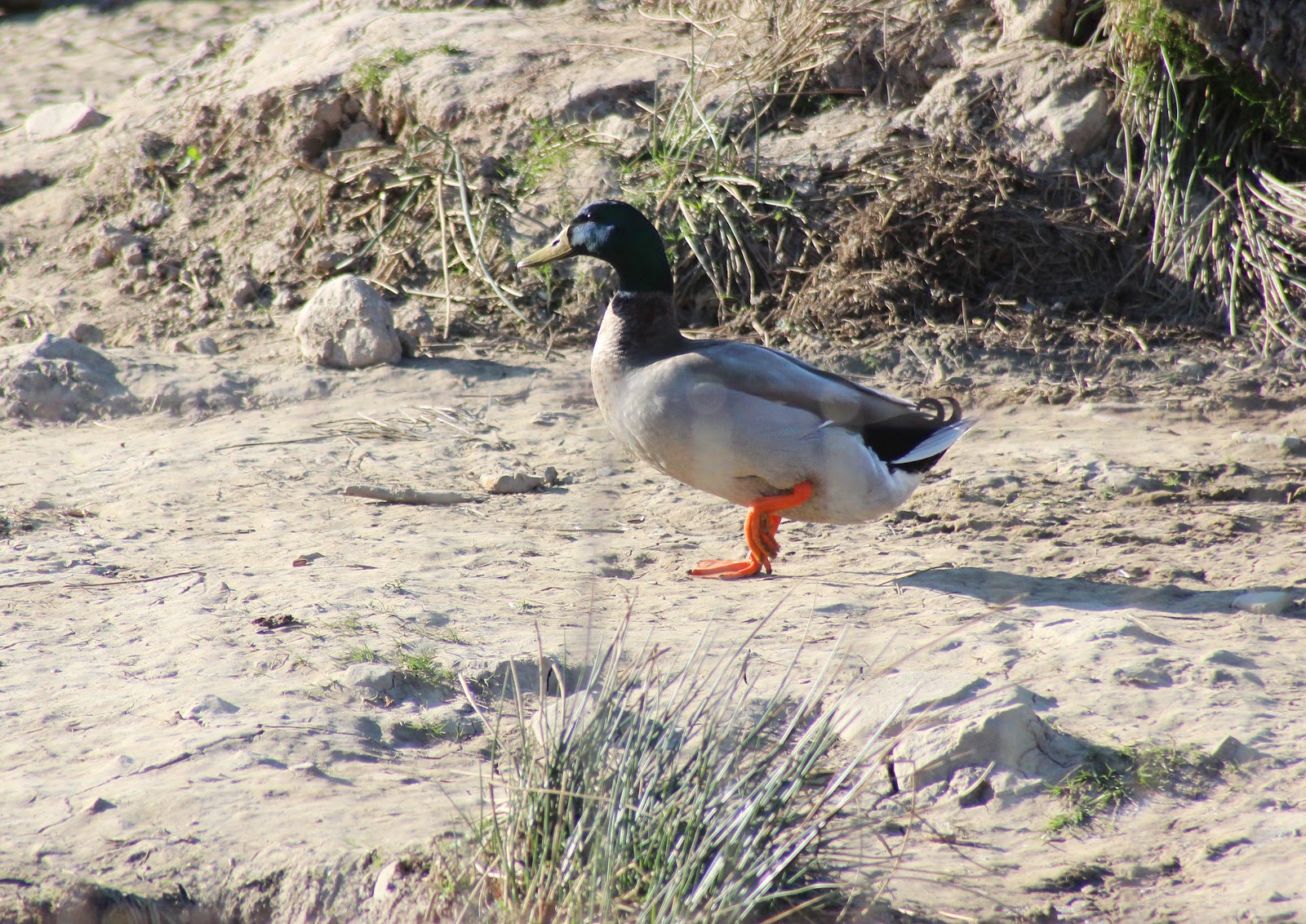
While the mallard is a permanent presence at the Sanctuary, the goosander duck is an occasional visitor to the surrounding rivers. They dive for fish, slicing through their prey with their razor bills.
Black headed gull (Chroicocephalus ridibundus)
There are a few gulls that hang around the Sanctuary, the most obvious being the black headed gull. In the summer its head is dark, and actually more brown than black. It can be seen here in its winter look. Another opportunist eater that thrives wherever morsels of food are left behind.
Magpie (Pica pica)
Magpies are a familiar sight just about anywhere in the UK, and the sanctuary is no different. Belonging to the corvid family, they are distinctively black and white, with a subtle greenish-blue sheen. Their size is extended considerably by the length of the tail. The magpie is omnivorous and appears content to turn most organic matter into a meal, which is probably a reason why it is such a successful species.
Jay (Garrulus glandius)
 |
Jay peering from behind a branch
|
In contrast, the jay seems a much shier corvid, whose appearances at the sanctuary have been largely restricted to the surrounding woodland verges, from which it will fly soon after being spotted. Much more colourful than the other corvids, it has a brown back and a striking flash of blue on its wing. Just about in shot here is its impressive black moustache. Jays share the corvid appetite for eggs, small birds and small mammals, but much of their diet consists of fruit, seeds, nuts and insects, with a particular fondness for acorns.
Jackdaw (Corvus monedula)
Flocks of jackdaws are a daily sight at the sanctuary, congregating in trees and foraging the open fields for insects and worms. Like other corvids, their adaptable eating habits are part of their success. They are an impressive sight when roosting, as hundreds take to the evening air, casting vast swirling shapes against the darkening sky. From a distance, they can be difficult to distinguish from other corvids, whose territories they often share, but they are smaller than the carrion crow, with pale eyes, and a silvery sheen to their crown.
Carrion crow (Corvus corone)
Unlike the jackdaw, the carrion crow is much more solitary, and rarely seen in anything more than a pair. The below crow was half of one such couple, but was in no mood to share its food. Only when it had finished did it allow its partner to come near.
The carrion crows are strong birds and can be quite fearless in the face of larger birds. During the summer, in the sanctuary's sky, one such crow - perhaps with nearby young - insistently saw off the attention and intention of a persistent red kite.
Red kite (Milvus milvus)
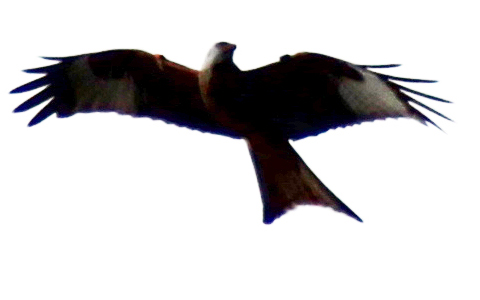
The red kite is one of the UK's great conservation success stories, having recovered from only a few birds to an estimated 1,000 breeding pairs in Wales alone (rspb.org.uk). Its forked tail makes it unmistakable in flight, as it soars across the sky with minimal movement to its wings. They will eat small birds and mammals, as well as eggs, but much of their food is carrion. They will also eat worms.
Sparrowhawk (Accipiter nisus)
Given the prevalence of small birds, it is not surprising to find a presence of sparrowhawks in and around the sanctuary. Seeing them is another matter however, as much of their time is spent in the surrounding woodland.
Common buzzard (Buteo buteo)
The common buzzard is another familiar sight in the skies above the Sanctuary, and occasionally as a flock, circling the air.
Photographed below is a particularly white common buzzard, which initially made it more difficult to identify. It was taken a little further down the River Tawe, hovering high in the air, before suddenly narrowing its body and dropping from the sky like a bullet.
There are doubtless numerous birds at the sanctuary that I have not recognised or been able to identify. Warblers are a notable absence, being a member of those small brown birds that can be difficult to tell apart. I will take a closer look at all the sanctuary's birds through 2013, and attempt to photograph the fascinating and beautiful kingfisher, that flies up and down the Tawe's verges.


.jpg)


+01.jpg)




+01b.jpg)